News
Why Are 18.5-Inch Touchscreen POS Terminals Popular? POS Hardware Guide
Why Are 18.5-Inch Touchscreen POS Terminals Popular in Some Markets?
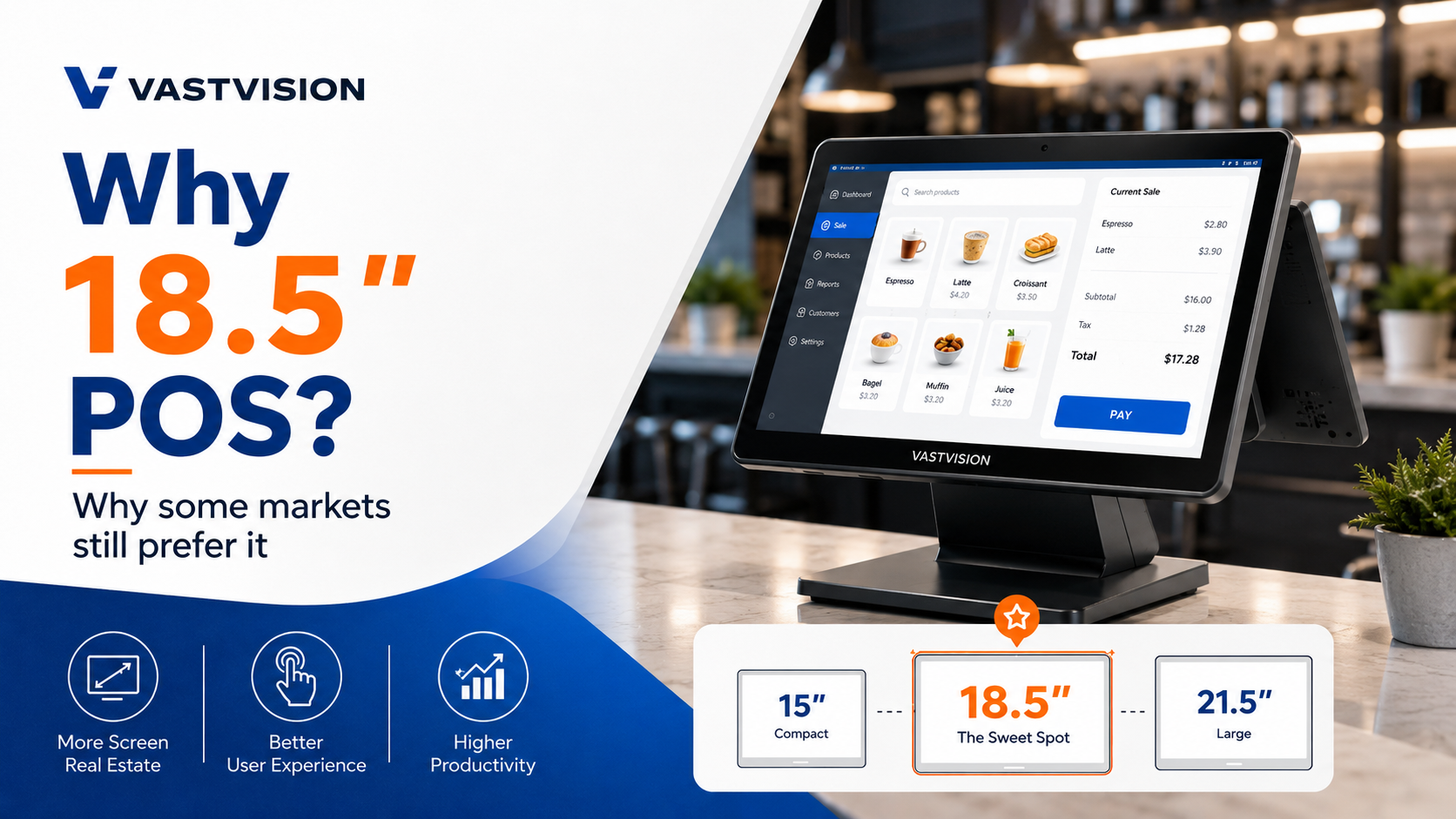
Why 18.5" POS Terminals Still Have a Strong Market
Most people in the POS industry are familiar with 15-inch and 15.6-inch touchscreen terminals.
But visit certain markets and you may notice something different:
18.5-inch touchscreen POS terminals are surprisingly common.
Why?
Because for some retailers and POS software providers, 18.5" offers something very practical:
More workspace than a traditional POS screen — without moving all the way to a large 21.5-inch terminal.
That makes it an interesting middle ground between compact POS hardware and modern large-screen systems.
1. More Screen Space for Modern POS Software
One of the biggest reasons is simple: software interfaces are becoming more complex.
Modern POS software may need to display:
Product images
Category menus
Order details
Customer information
Promotions
Payment options
Inventory information
On a smaller screen, too much information can make the interface feel crowded.
An 18.5-inch touchscreen gives software developers more usable screen area, allowing larger buttons and more information to appear on one page.
For restaurants and retail stores, this can reduce unnecessary screen switching during checkout.
2. A Practical Step Between 15.6" and 21.5"
An 18.5-inch POS terminal occupies an interesting position.
A 15.6" screen is compact and efficient.
A 21.5" screen provides excellent visibility, but it may be too large for some checkout counters.
The 18.5" format sits between them.
It offers:
More visual space than 15.6"
Less counter space than many 21.5" systems
For stores that want a larger interface without creating an oversized checkout station, this can be a very practical choice.
3. Widescreen Layout Works Well With New POS Interfaces
18.5-inch POS terminals typically use a widescreen format.
This is particularly useful for software interfaces designed with:
Product selection on one side + order information on the other.
For example, a restaurant POS interface may show:
| Product Categories | Current Order |
|---|---|
| Food | Items |
| Drinks | Quantity |
| Desserts | Price |
| Add-ons | Payment |
Instead of constantly moving between different pages, the operator can see more information at once.
This is one reason widescreen POS hardware is increasingly attractive to software companies designing modern user interfaces.
4. Bigger Touch Targets Can Improve Operator Experience
POS systems are used continuously.
In a busy restaurant or retail store, operators may perform hundreds of touchscreen actions every day.
A slightly larger display allows software designers to use:
Larger buttons
Larger product images
More spacing between functions
More readable text
This can make the POS system easier to operate, especially in high-volume environments.
The important point is not simply having a larger screen.
It is about giving the software more freedom to create an efficient user interface.
5. Some Markets Simply Developed Around 18.5" Hardware
POS hardware preferences are also influenced by local market history.
Once software companies, distributors and system integrators become familiar with a particular hardware format, that size can become part of the local POS ecosystem.
Their software interfaces may already be optimized for it.
Their customers may already recognize it.
Their installation teams may already understand it.
And their spare-parts strategy may already be built around it.
This creates an important reality in the POS industry:
The most popular POS size is not always the same in every country.
Hardware standards often develop together with local software, distributors and customer habits.
6. 18.5" Can Work Well for Customer-Facing Applications
Another advantage is visibility.
An 18.5" screen is large enough to display more visually attractive content, such as:
Product photos
Promotions
Membership information
Digital receipts
Ordering menus
This makes it useful not only as a traditional cashier POS terminal, but also for applications where the screen becomes part of the customer experience.
For example:
Fast food restaurants
Cafés
Fashion retail
Supermarkets
Hospitality
Self-ordering applications
In these environments, screen presentation can be almost as important as transaction functionality.
15.6", 18.5" or 21.5" — Which POS Size Is Better?
There is no universal answer.
Choose 15" or 15.6" when:
You want compact hardware, limited counter footprint and a traditional cashier-focused POS system.
Choose 18.5" when:
You need more software workspace while still keeping the terminal relatively compact.
Choose 21.5" when:
Large product images, customer interaction, self-service functions or highly visual interfaces are important.
The correct decision should start with the software interface and application scenario, not simply the screen specification.
What POS Software Companies Should Consider
When POS software companies select hardware, screen size is only one part of the decision.
We normally recommend evaluating:
Screen resolution and aspect ratio
Touch responsiveness
CPU performance
Fanless or fan-cooled design
Windows or Android compatibility
POS peripheral interfaces
Customer display options
VESA mounting
Spare-parts availability
Product lifecycle
Long-term supply consistency
This becomes increasingly important when a software company moves from a small number of installations to hundreds or thousands of terminals.
Hardware standardization can eventually become just as important as hardware specifications.
Final Thought
The popularity of the 18.5-inch touchscreen POS terminal in certain markets is not accidental.
It offers a practical middle ground:
More screen space than 15.6"
More compact than 21.5"
Better suited to widescreen POS software
For some POS software companies and system integrators, that balance is exactly what their market requires.
At VastVision, we manufacture touchscreen POS hardware for POS software companies, distributors and system integrators, with screen sizes including 15", 15.6", 18.5" and 21.5", as well as dual-screen configurations and OEM/ODM customization.
The goal is not to push every customer toward the same screen size.
The goal is to match the hardware platform to the software, the checkout environment and the long-term deployment strategy.
RELATED NEWS
- Why Are Most Touchscreen POS Terminals 15 or 15.6 Inches? POS Hardware Guide 2025-01-18
- self ordering kiosk scenary & advantage & disadvantage 2026-03-13
- application scenarios of customer display and how to deploy 2024-01-15
- How to choose capacitive touch or resistive touch monitor 2019-02-16
- the importance of embedded displays and Mini-PCs for self-service terminals (k 2025-02-06
CATEGORIES
LATEST NEWS
CONTACT US
Contact: Cherry Jiang
Tel: 0755-89329286
E-mail: info@vastvision.com.cn
Whatsapp:0086-13530966019
Add: Bldg. 4, Lane A, Shangxue City,Science and Technology, Longgang District,ShenZhen,GuangDong Province
