News
the importance of embedded displays and Mini-PCs for self-service terminals (kiosks)
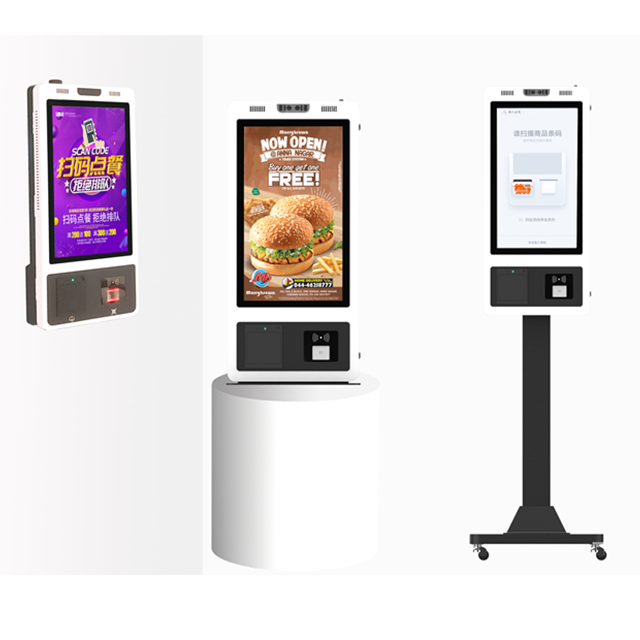
why the importance of embedded displays and Mini-PCs goes without saying for manufacturers of self-service terminals (kiosks) and self-service equipment
If we were to liken a self-service terminal to a human being, the Mini-PC would serve as the "heart" and "brain"—processing all information and controlling every action—while the embedded display would act as the "eyes,
" facilitating human-machine interaction and presenting information.
This is because the operating environment and operational characteristics of self-service terminals impose extremely rigorous and specific requirements on these two core components. We will conduct an in-depth
analysis of this premise across the following key dimensions:
1 ,Physical Architecture and Integration: The Compactness of Direct Embedded Chassis Self-service terminals typically have very limited internal space, and their exterior design often requires customization
(wall-mounted, floor-standing, desktop, etc.).
Why do kiosk manufacturers tend to choose open-frame displays or Bezel-free Touchscreen when selecting embedded monitors?
Open Frame: Manufacturers require displays that lack a front bezel—featuring only a metal rear enclosure or a bare screen assembly. This configuration allows them to easily mount the display from the interior
of the host chassis onto a designated cutout, thereby achieving a "flush" integration between the screen and the enclosure.
Bezel-free Touchscreen: A modern design trend is the bezel-free capacitive touchscreen, which is both aesthetically pleasing and easy to clean (as it does not accumulate dust or trap debris).
2,Environmental Adaptability and Stability: Thermal Management and Industrial-Grade Quality
Why kiosk requiried the fanless mini pc with passive cooling ?
Self-service kiosks typically operate 24/7 in complex environments (such as shopping malls, train stations, outdoor locations, and factory workshops). The equipment must maintain long-term stability within a sealed
internal enclosure that functions like a “black box.”
Thermal Management (The Heat Challenge): The interior of the enclosure is a closed space. If a Mini-PC uses fan-based cooling, the entire system will overheat and crash if the fan fails. Therefore, the fan is the primary source of failure risk.
Solution: Manufacturers must adopt industrial-grade fanless Mini-PCs. These devices utilize a rugged, corrugated aluminum alloy chassis for passive cooling. This design addresses thermal management challenges and prevents motherboard damage caused by dust and oil being drawn in by fans.
3. Functional Integration and Business Execution: Extensive Interfaces
why choose industrial -grade computers instead of consumer-grade computers in the kiosk ?
A self-service terminal is more than just a computer; it must control various peripheral devices to complete business processes (card reading, printing, cash acceptance, and facial recognition).
Serial Ports (COM Ports): The most critical distinguishing feature of industrial-grade products. Although serial ports have long been phased out in consumer-grade computers, most self-service peripherals (card issuers, thermal printers, barcode scanners, PIN pads, and bill/coin acceptors) still rely heavily on RS-232 serial ports. A qualified Mini-PC typically requires 4, 6, or even 8 industrial-grade serial ports.
·USB Ports: High-definition cameras (for facial recognition), ID card readers, and biometric modules typically use USB. A Mini-PC requires a sufficient number of USB ports with stable power supply (including industrial-grade lockable USB ports to prevent disconnection).
·Dual Ethernet Ports/Wireless: One Ethernet port connects to the internal network (for transmitting business data), while the other connects to the external network (for remote maintenance and monitoring cameras), or integrates 4G/5G/Wi-Fi modules.
·Multi-display support: Some terminals require a main touchscreen and a top advertising display, which necessitates a Mini-PC motherboard that supports independent dual-display output via multiple interfaces such as HDMI, VGA, and DisplayPort.
·Embedded display interfaces: In addition to standard display interfaces, manufacturers typically require that the touchscreen module be directly connected internally to the Mini-PC via a USB interface.
4. Lifecycle Management and Supply Chain Considerations: Long Lifecycle and Maintainability
Why do kiosk manufacturers need to focus on product lifecycles and a consistent, stable supply?
The design, certification, and deployment cycles for self-service kiosks are lengthy.
· Long Lifecycle: Consumer-grade Mini-PCs (such as standard NUCs) are updated every one or two years. Manufacturers cannot accept this level of change because every time a motherboard model is updated, they must redesign the mounting holes inside the chassis, adjust peripheral drivers, and even re-obtain relevant industry certifications.
· Solution: Products from an industrial-grade supply chain must be used. Industrial motherboards typically guarantee a stable supply cycle of 5 to 7 years. Manufacturers can deploy them with confidence, without worrying about spare parts being discontinued or specifications changing.
-----------------------------------------------------------------------------------------------------------------------------------------------------------------------------------------------------------------------------------------------------------
Vast Vision Industry Co,.Ltd is a Chinese manufacture of computer hardware , mini pc , industrial grade embedded touch screen display ,more details, contact us via info@vastvision.com.cn
RELATED NEWS
- Why Are Most Touchscreen POS Terminals 15 or 15.6 Inches? POS Hardware Guide 2025-01-18
- self ordering kiosk scenary & advantage & disadvantage 2026-03-13
- application scenarios of customer display and how to deploy 2024-01-15
- How to choose capacitive touch or resistive touch monitor 2019-02-16
- Why choose fanless pos system 2025-06-15
CATEGORIES
LATEST NEWS
CONTACT US
Contact: Cherry Jiang
Tel: 0755-89329286
E-mail: info@vastvision.com.cn
Whatsapp:0086-13530966019
Add: Bldg. 4, Lane A, Shangxue City,Science and Technology, Longgang District,ShenZhen,GuangDong Province
