News
Why Are Most Touchscreen POS Terminals 15 or 15.6 Inches? POS Hardware Guide
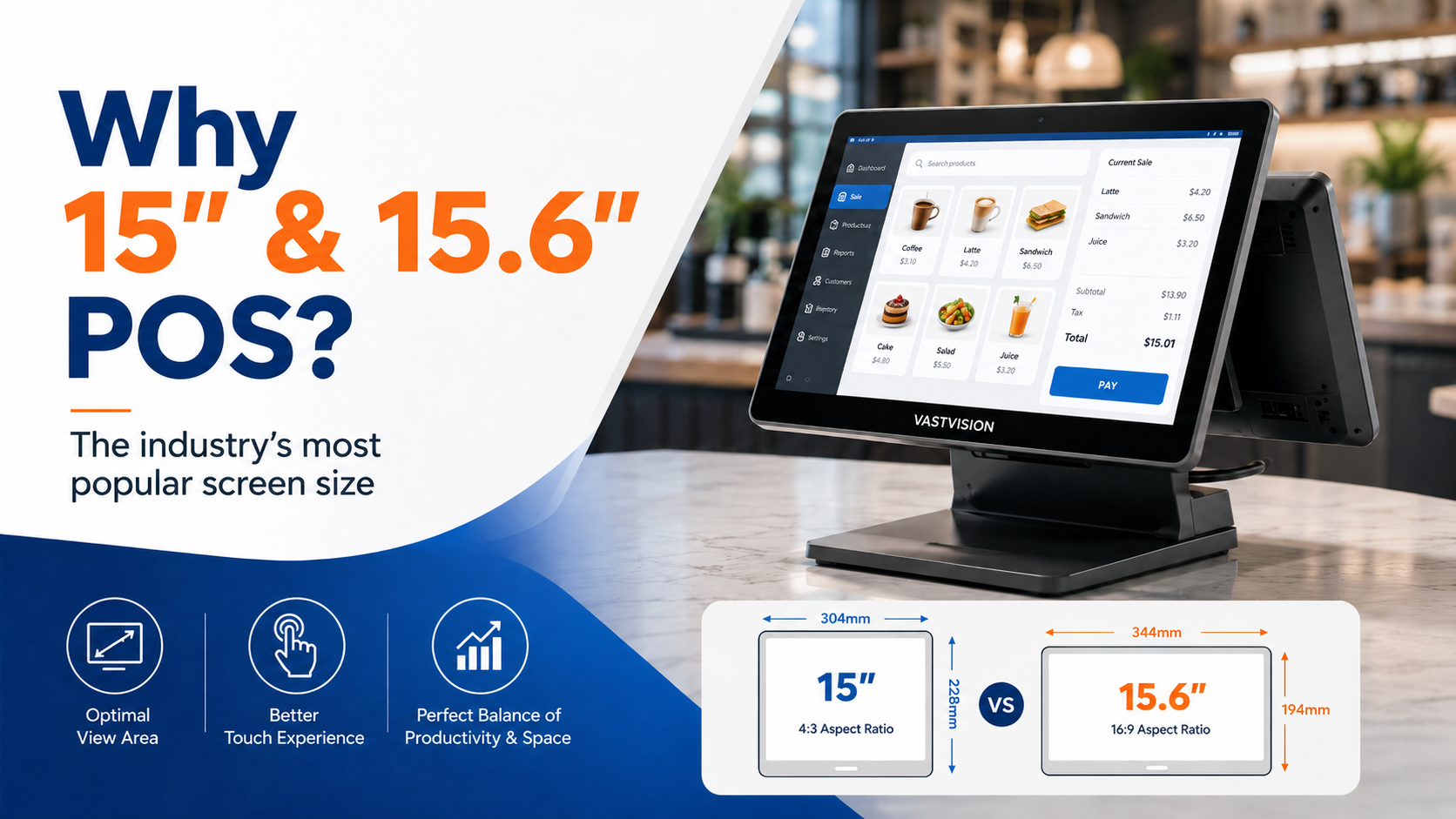
Why 15" and 15.6" Became the Sweet Spot for POS Hardware
Walk into a restaurant, retail store, pharmacy, supermarket or hotel reception, and you will probably notice the same thing:
Most touchscreen POS terminals are around 15 or 15.6 inches.
Why not 12 inches? Why not 21.5 inches?
The answer is not simply tradition.
After years of POS hardware development, 15" and 15.6" have become a practical balance between screen visibility, touch operation, counter space, hardware cost and software compatibility.
For POS software companies, distributors and system integrators, understanding this size standard can also make hardware selection much easier.
1. Large Enough for Fast Touch Operation
A POS screen must do more than display information.
Cashiers continuously touch:
Product buttons
Categories
Payment options
Discounts
Order details
Customer information
If the screen is too small, buttons become crowded and operators are more likely to make mistakes.
A 15-inch or 15.6-inch touchscreen provides enough space for comfortable touch targets while keeping the interface easy to scan quickly.
This becomes particularly important during busy restaurant or retail periods, where even a few seconds saved per transaction can improve checkout efficiency.
2. Small Enough for the Checkout Counter
Counter space is extremely valuable.
A POS terminal often needs to share the same workspace with:
Receipt printers
Barcode scanners
Payment terminals
Cash drawers
Customer displays
Label printers
A 21.5-inch display may offer more screen space, but it also occupies considerably more room.
A 15" or 15.6" POS terminal provides a good compromise:
Enough display area for POS software, without dominating the checkout counter.
That is one reason these sizes remain popular in convenience stores, cafés, restaurants, pharmacies and specialty retail stores.
3. 15" and 15.6" Serve Two Different POS Design Generations
Although the sizes look similar, they are commonly used in slightly different POS designs.
15-Inch POS Terminal
Traditional 15-inch POS terminals often use a more square display format.
This layout has been popular for many years because traditional POS software frequently uses vertically arranged product categories, order lists and payment buttons.
It remains especially common in:
Retail POS systems
Supermarkets
Convenience stores
Pharmacy POS
Legacy POS software deployments
15.6-Inch POS Terminal
15.6-inch screens normally use a widescreen format.
This gives software developers more horizontal space for modern interfaces, dashboards, product images and multi-column layouts.
As POS software becomes more visually sophisticated, 15.6-inch touchscreen POS terminals are becoming increasingly attractive for modern retail and hospitality applications.
They are particularly suitable for:
Restaurant POS
Café POS
Hotel reception
Modern retail
Cloud POS systems
Dual-screen POS configurations
4. Better Balance Between Performance and Hardware Cost
POS hardware is normally deployed in volume.
A software company may start with 20 terminals and eventually need hundreds or thousands.
At that point, every hardware decision matters.
Larger screens increase costs not only for the LCD panel itself, but potentially also for:
Touch panels
Housing materials
Packaging
Shipping
Stands
Power consumption
15" and 15.6" displays are widely used across the electronics industry, which helps manufacturers build POS terminals around a mature and cost-efficient supply chain.
For large POS deployments, this makes the size particularly practical.
5. Easier Integration With POS Accessories
A POS terminal rarely works alone.
Modern systems may include:
POS Terminal + Customer Display + Printer + Scanner + NFC + MSR + Cash Drawer
The main display must therefore leave enough physical space for these peripherals.
15-inch and 15.6-inch terminals are compact enough to create a clean workstation while still providing sufficient screen space for the operator.
They are also well suited to dual-screen configurations.
For example, a 15.6-inch main touchscreen combined with an 11.6-inch customer display can provide a professional setup without making the system unnecessarily bulky.
6. Familiar Hardware Means Easier Deployment
For POS software providers, choosing unusual hardware sizes can create additional work.
Different screen resolutions or aspect ratios may require:
UI adjustments
Software testing
Touch calibration
Driver verification
New mounting solutions
Different packaging and spare parts
Using widely adopted 15" or 15.6" platforms simplifies deployment.
This is especially important for POS software companies expanding from dozens of installations to hundreds of locations.
Standardized hardware can significantly reduce complexity in:
deployment, maintenance, spare parts and after-sales support.
15" or 15.6": Which One Should You Choose?
There is no single answer for every POS project.
Choose 15-inch POS hardware when you need a compact traditional POS format or need to support existing software designed around a more square interface.
Choose 15.6-inch POS hardware when your software uses a modern widescreen UI, more product images, wider dashboards or dual-screen configurations.
For many new POS projects today, 15.6 inches offers an excellent balance between modern design, usability and counter space.
The Screen Size Is Only Part of the POS Hardware Decision
A reliable POS terminal should not be selected by screen size alone.
For commercial deployments, we recommend evaluating:
Fanless or fan-cooled architecture
Aluminum or plastic housing
Touchscreen technology
Port configuration
CPU platform
Windows or Android compatibility
Customer display options
MSR / NFC / scanner integration
VESA mounting
SSD accessibility
Spare-part availability
Long-term supply stability
For POS software companies in particular, hardware consistency and long-term availability can be more important than saving a few dollars on the initial purchase.
A POS system may operate for five years or longer. The real cost appears when replacement units, spare parts or compatible models are no longer available.
Final Thought
The popularity of 15" and 15.6" POS terminals is not accidental.
They sit at the intersection of ergonomics, counter space, software usability, hardware cost and supply-chain maturity.
That is why these sizes have remained among the most widely adopted formats in the global POS industry.
At VastVision, we develop and manufacture touchscreen POS hardware for POS software companies, distributors, system integrators and hardware resellers.
Our POS solutions include 15" and 15.6" all-in-one POS terminals, dual-screen POS systems, touch monitors, Mini PCs, KDS displays and self-service kiosk hardware, with OEM/ODM customization available.
If you are building or upgrading a POS hardware platform, choosing the right screen size is only the beginning.
The bigger question is whether your hardware supplier can support the same platform consistently as your business scales.
RELATED NEWS
- self ordering kiosk scenary & advantage & disadvantage 2026-03-13
- application scenarios of customer display and how to deploy 2024-01-15
- How to choose capacitive touch or resistive touch monitor 2019-02-16
- the importance of embedded displays and Mini-PCs for self-service terminals (k 2025-02-06
- Why choose fanless pos system 2025-06-15
CATEGORIES
LATEST NEWS
CONTACT US
Contact: Cherry Jiang
Tel: 0755-89329286
E-mail: info@vastvision.com.cn
Whatsapp:0086-13530966019
Add: Bldg. 4, Lane A, Shangxue City,Science and Technology, Longgang District,ShenZhen,GuangDong Province
